

My Time with AI
How I know AI Startups are Lying to us.

This image below is from the AI I worked on with my startup co-founder in 2017. This is a real production screenshot, and it ran on a consumer grade cellphone. That’s me, and my co-founder Majella is in the background. I worked 12 hour days for 3 months to get it working for our demo day in front of investors.
It was close to the end of that when we cracked it and got it working, and we both started using it on our phones. We are here in the Accelerator program that we won a spot in. Exhausted but thrilled.
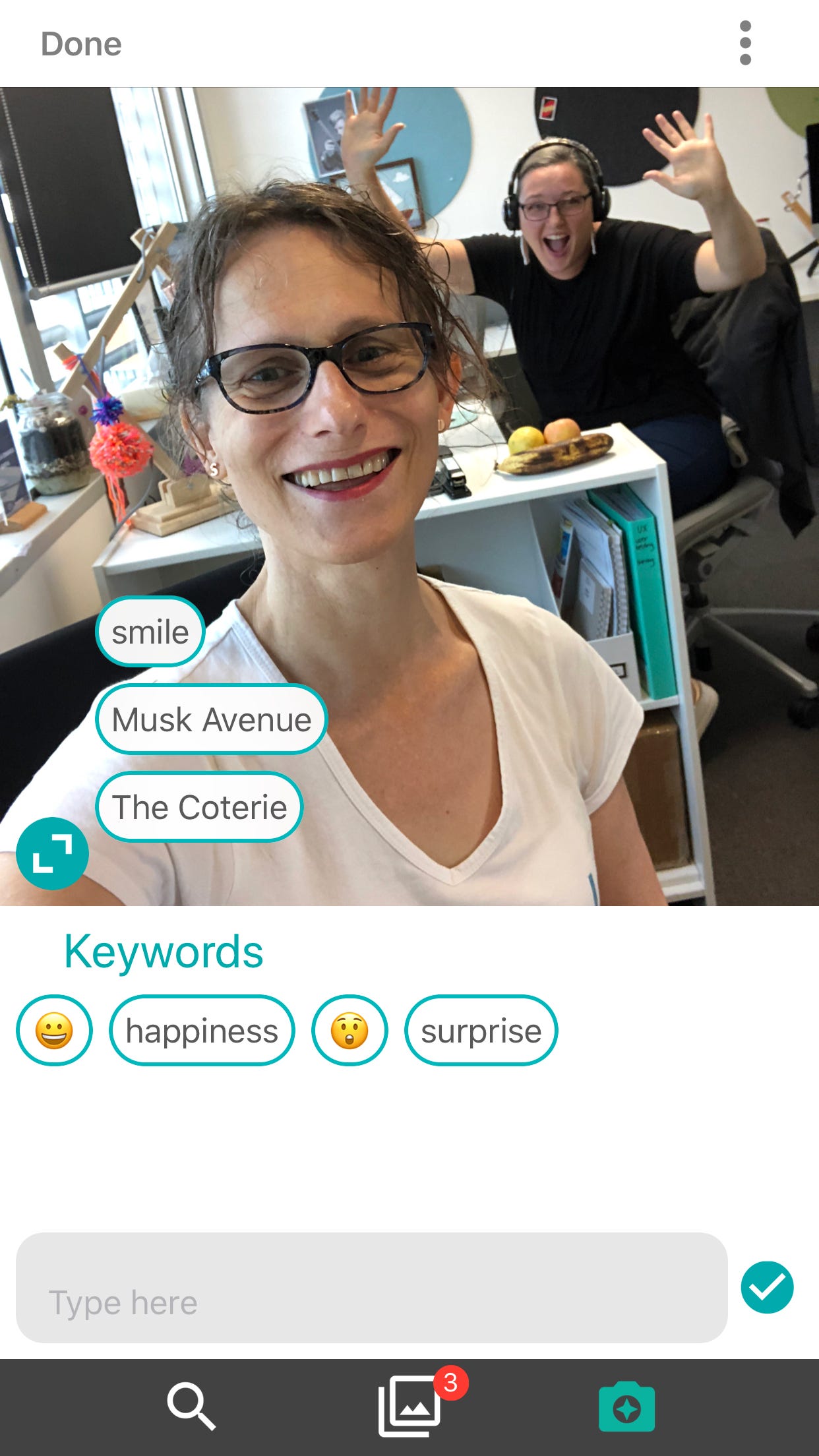
It used a pluggable array of expert system rules, with front end recogniser elements as simple as kMeans clustering for main colour detection, through Haar cascades for faces, GPS location, and Google’s inception v3 model retrained for our use-case to input item detection labels.
I compiled a custom version of Tensor Flow C++ and a re-trained Inception-v3 quantised model and ran it on the cellphones we used. With this architecture it “reasoned” in a very basic sense.
But it was the equivalent of a magician who knows a hundred parlour tricks. If it detected maroon jumpers at a certain location that others had associated with Rugby League games occurring at the time, its a decent guess its “State of Origin Football” (confected example). We had a patent application, but when the company folded we decided not to defend it.
The Pressure to Fake it Until you Make it
If you allow it to work on only staged scenarios and never look behind the curtain it worked great. There’s a feeling when you’re running a startup that you just need to fake it until you make it - its OK if it only works 80% of the time, we’ll fix the rest once we get funded.
Around the same time as we were pitching our tech, an AI health startup got its subsequent rounds of funding and hired many more engineers. I won’t say which one it was, and I’m being deliberately vague but they were well known.
I got talking to some of them over drinks at a function and asked “Hey, has your system been working well enough in the field?” - The blood drained from the guys face, and he looked around. He leaned in and whispered, “It doesn’t work in the field at all.”
The blood drained from the guys face, and he looked around and whispered, “It’s not working in the field at all.”
The only thing that really amazes me about AI is not the technical advances but the breathtaking pace with which AI tech Bros will shamelessly over hype its capabilities.
Just look at history. Recent history.
FTX - Sam Bankman-Fried. Hailed as a crypto genius. Now known as a fraud. Millions invested and lost.
Theranos - Elisabeth Holmes. Medical startup and huge hype. Now in prison.
But we see people like Sam Altman - who, remember was sacked from OpenAI and then sued by one-time backer Elon Musk - and we think he cannot be a fraud, because he seems so successful.
Sitting at the top of OpenAI, he seems untouchable. Even despite the dozens of lawsuits against him.
today at the top of a massively successful startup, hailed as a tech genius and lauded by the press … tomorrow … vilified as a fraud
Just because someone is today at the top of a massively successful startup, hailed as a tech genius and lauded by the press is no guarantee that tomorrow they will be vilified as a fraud. And this is not a statement about the vicissitudes or fickleness of fame, it’s about justice (sometimes) finding its mark and bringing down fraudsters.
Today’s Generative AI… a Fraud?
Every day of my professional life I was guided by an inviolable principle when I developed intellectual property as professional engineer: I would never copy someone else’s code and pass it off as my own. My job, my credo as a professional engineer, was that I stood behind my work.
Early in my career I was managing a younger woman engineer in a project. Let’s call her Ann. She was a student at the time. I found when I was doing a code review, some of her code looked strange. There was a comment and some other lines that did not match the rest of the code style.
I went and confronted her and asked what had happened. She had been working on some code, gotten blocked and instead of coming to me, had chatted online to some friends from her course, then cut and pasted several files from the project into a sharing site. The friends came back with code which she then pasted into our project. It turned out to have been taken - around 20 lines - from Stack Overflow.
She could not explain the code to me. She had exposed the project to legal peril, if we had tried to commercialise the project - which was the intent. She could not support the code in production, because she couldn’t explain how it worked. She had pasted our code, shared it to folks outside the centre. I had to let Ann go. It was awful.
Now, with Generative AI, Sam Altman has waved a magic wand and thinks he can sweep away all the copyright and intellectual property problems that a million Ann’s will create by wholesale using code that is not theirs.
It shows a catastrophic ignorance of how software and intellectual property works.
AI tries to make Software IP Theft and Copyright Breach a Business
To me, this is the single biggest problem with Generative AI. Its overnight tried to just make a core tenet of software development go away with a wave of the hand.
To be clear the problem is the feeding into AI models unwashed third party code, and then having the AI regurgitate that code into production projects.
I have heard all the explainers about how this is not true: they are all garbage.
Claim: AI is there to make engineers more productive, they have to check the code being produced by generative AI, and then test it and vouch for it.
Reality: The young engineers who use it won’t do this. I guarantee that. Especially as big tech grinds them down, and pays them less, based on their use of AI. As a very Senior Engineer I left tech in part because of this trend. The young engineers being made to be stool pigeons for AI, are there just to provide cover for the company if it’s sued over copyright breach or IP theft.
Claim: AI is not regurgitating, it’s “learning” and then creating whole new solutions. The code that is created is yours.
Reality: I consulted with a startup that was building an app to do event invitations. They called me in when their developers failed to deliver, and I did a code audit: they got cut-n-pasted code that was from non open source projects on GitHub. Trivial searched found this massive breach of IP, and failure to actually write custom code. We’ll never know if it was AI or not, but it doesn’t matter. That is what AI is trained on.
Claim: AI will make you a better, more productive engineer.
Reality: Even if you ignore all the mind-bogglingly, eye-gougingly awful consequences of piping a million half-baked buggy, student assignments and hackathon projects into your codebase; there is no way AI is good for you. It saves typing, if you hate typing. For me typing code is how I understand it. As I type code, I am processing it, modelling what it will do when executed. AI takes that away. It does not make me faster or better. And for young inexperienced programmers it’s disastrous. The temptation is there to just paste and paste and paste until something works.
Where Does this Leave Us?
With a job! Great, right?
The point of this article is that when Generative AI hucksters say AI can make production grade code that will help you deliver products and get real work done they are lying.
So younger folks should learn how to program.
And we should all watch this space for a big correction to come for OpenAI.